
Quick wins
Changes achievable within months.
Administrative and operational improvements that can begin without waiting for wholesale legislative reform – reviewing remand cases, listing the oldest cases, tightening custody records.
It is to identify what needs to change.
The Action Matrix turns findings into a sequenced set of actions. It links priorities to evidence and identifies the institutions responsible for implementation.
| Institution | Finding | Action | Responsible | Timeframe | Indicator |
|---|---|---|---|---|---|
| P4Police | Suspects are held beyond legal time limits; custody registers are incomplete. | A standard custody register, with a daily supervisory review. | Police | Quick win0–6 months | Share of detainees brought before a court within the legal time limit |
| P3Prosecution | Hearings are adjourned because files are incomplete or witnesses have not been summoned. | A joint police–prosecution file-readiness check before a case is listed. | Prosecution service, with police | Quick win0–6 months | Adjournments per case, by recorded reason |
| P2Courts | The backlog is concentrated in a few high-volume courts, where the oldest cases wait longest. | A Court Audit to develop Case Management Orders (CMOs) targeting the oldest pending cases. | Judiciary and court administration | Quick win0–6 months | Clearance rate; age of the pending caseload |
| P6Courts | Paper registries leave no reliable record of case age or status across institutions. | Electronic case management, with one case identifier across the justice chain. | Ministry of Justice and judiciary | System reform12–36 months | Share of courts reporting case data electronically |
| P1Prisons | A large share of prisoners are unsentenced; some have been held longer than the likely sentence. | A case-by-case review of remand detainees eligible for lawful release. | Prison service, with prosecution and courts | Quick win0–6 months | Number of remand cases reviewed; lawful releases; duration of pre-trial detention |
| P5Legal aid | Legal aid is concentrated in the capital; few accused are represented at first appearance. | A funded national scheme of early legal advice, with paralegals in under-served districts. | Legal aid body, Ministry of Justice and bar association | System reform12–36 months | Share of accused with advice at first appearance, by district |
The findings, actions, rankings and timings are illustrative. P1 is the highest priority. In an assignment, priorities are assessed against urgency, likely impact, feasibility and cost.
The dashboards allow Justice Investment Options to be filtered by type of investment, case process stage, target institution and justice value added; the Ethiopia dashboard also includes a UN agency filter. Selected Sri Lanka Action Matrix options are reproduced below; filter them by type of investment.
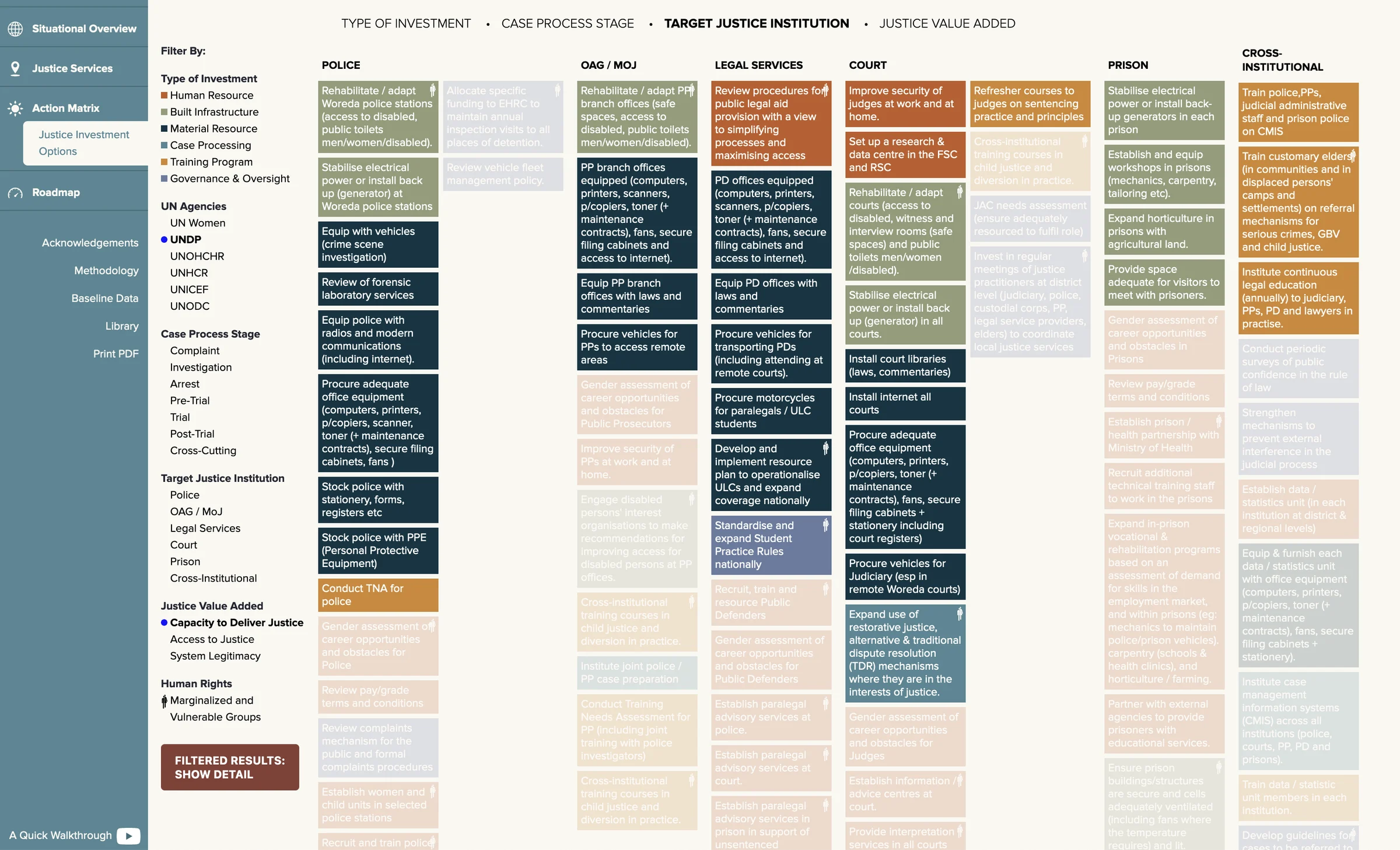
Police
AGD
Legal services
Court
Prison
Cross-institutional
The Action Matrix separates the two, so early, visible results do not wait for structural reform – and structural reform is not mistaken for a quick fix.
Quick wins
Administrative and operational improvements that can begin without waiting for wholesale legislative reform – reviewing remand cases, listing the oldest cases, tightening custody records.
System reforms
Structural reforms carried through a mandate – legislation, information systems, infrastructure and people – sequenced so that each builds on the evidence of the last.
Priorities are ranked by
The Roadmap sets out agreed measures of progress to track implementation over time. The illustrative example below uses 12, 24 and 36 months.
Illustrative example – all baselines, targets and measured values below are fictional.
| Indicator | Baseline | 12 months | 24 months | 36 months |
|---|---|---|---|---|
| Pre-trial detainees as a share of the prison population | 70% | target 62%, measured 61% (on track) | target 55%, measured 59% (off track) | target 48% |
| Clearance rate in priority courts | 82% | target 90%, measured 91% (on track) | target 95%, measured 97% (on track) | target 100% |
| Accused with legal advice at first appearance | 12% | target 25%, measured 18% (off track) | target 40%, measured 41% (on track) | target 60% |
Its transparency promotes accountability – which makes the Roadmap a powerful tool of governance.
The Sri Lanka Justice Snapshot set 2024 baselines for justice sector resources, with targets for 2026, 2028 and 2030. The table presents selected resource indicators, showing available 2024 baseline data and targets or qualitative goals through 2030.
Share of institutions, 0–100%
| Indicator | 0%100% | Baseline 2024 | 2026 | 2028 | 2030 |
|---|---|---|---|---|---|
| Lower courts with access to the internet | 72% | 75% | 85% | 100% | |
| Lower courts with digital recording facilities | 10% | 15% | 60% | 100% | |
| Lower courts with display monitors | 30% | 40% | 75% | 100% | |
| Courts with victim-sensitive infrastructure | 50% | 60% | 80% | 100% | |
| Courts with adequate security, including equipment | 55% | 60% | 80% | 100% | |
| Judicial residences with adequate security | 14% | 20% | 50% | 100% | |
| Circuit and remote courts with transport | 0% | 5% | 50% | 100% | |
| LACs with a full complement of administrative staff | 70% | 75% | 85% | 100% | |
| Police and prisons providing prompt access to legal aid services | No data | 10% | 25% | 50% | |
| Prisons with minimum healthcare staffing norms (WHO) | 2.5 per 1,000 prisoners | — | — | 5 per 1,000 prisoners | |
| Prisons with asset-management framework | 30% fleet >10 years old | — | — | — | |
| Prisons in PPPs with community-based providers | No data | — | — | 100% |
The Audit is intended to be updated at regular intervals. Justice Snapshots repeat the core indicators, so the direction and pace of change can be seen – and progress is demonstrated rather than asserted.
Establish what is actually happening.
Target the bottlenecks.
Measure what changed.
Justice in 100 Days – a proposed cycle across a mandate
Justice in 100 Days
National researchers and practitioners work with teams drawn from the network maintained by Governance and Justice Group (GJG) and Justice Mapping (JM). They help collect, analyse and validate the evidence, building capacity to maintain and update Justice Audit data.
“The data belong to the government and institutions concerned.”
Start with a conversation about a specific problem. Choose the one closest to yours and tell us a little about your context.